
“What does fulfillment cost?” is the most common question in our first conversations – and the one least often answered honestly. Most providers quote a pick-&-pack price and say nothing about the rest. This article breaks fulfillment costs down into all their components, shows typical market benchmarks for Switzerland and Germany, works through a complete example with 500 shipments per month and compares it with running your own warehouse. By the end, you will know which number to demand from every provider: the cost per order, all inclusive.
The eight cost components
A fulfillment invoice is made up of line items that scale differently: some are charged per order, some per item, some per month. Once you understand this, you can compare quotes.
- Onboarding and integration. One-off: connecting your shop or ERP, setting up the product master data, initial stock placement, training. Many providers charge a flat fee for this; some waive it.
- Goods receipt. Per pallet, per carton or per unit: acceptance, counting, checking, putting away. It gets more expensive if every unit has to be individually inspected, labelled or recorded with batch number and expiry date.
- Storage. Per pallet space, shelf or cubic metre per month. This is the component you have the most control over: keep your stock lean and you pay little.
- Pick & pack. The core: a base fee per order plus an amount for each additional line item. An order with three different items costs more than one with a single item.
- Packaging material. Box or mailing bag, void fill, tape. Charged either per shipment or at material cost; with your own branded packaging, this is where you save.
- Postage. The biggest item – in B2C often more than half of total logistics costs. Fulfillment providers pool volume and pass on their framework contract rates.
- Returns. Per return: acceptance, inspection, restocking – plus refurbishment if goods need to be cleaned, repackaged or steamed.
- Value-added services. Inserts, kitting, bundles, gift wrapping, labelling, customs clearance, B2B pallet shipping. All priced individually – and all optional.
2026 benchmarks for Switzerland and Germany
These are the ranges we currently see in the market. Switzerland is around 15–25 % above Germany because of wages and postage.
| Component | Unit | Switzerland (CHF) | Germany (EUR) |
|---|---|---|---|
| Onboarding | one-off | 0 – 2’000 | 0 – 1’500 |
| Goods receipt | per pallet | 20 – 40 | 15 – 30 |
| Goods receipt with per-unit inspection | per unit | 0.15 – 0.40 | 0.10 – 0.30 |
| Storage, pallet space | per month | 15 – 25 | 10 – 18 |
| Storage, shelf | per month | 4 – 8 | 3 – 6 |
| Pick & pack base fee | per order | 2.00 – 3.50 | 1.60 – 3.00 |
| Each additional line item | per line item | 0.30 – 0.80 | 0.25 – 0.60 |
| Packaging material | per shipment | 0.40 – 1.50 | 0.30 – 1.20 |
| Postage, parcel up to 2 kg, domestic, framework contract | per shipment | 6.50 – 9.00 | 4.00 – 5.50 |
| Return incl. inspection | per return | 3.00 – 6.00 | 2.50 – 5.00 |
| Insert (flyer, card, sample) | per shipment | 0.20 – 0.50 | 0.15 – 0.40 |
| Kitting / bundle | per set | 0.50 – 2.00 | 0.40 – 1.50 |
| Customs clearance, consolidated shipment CH ↔ DE | per declaration | 60 – 150 | 50 – 120 |
Two things stand out: first, postage costs almost as much as all the other components combined. Second, the differences between providers on pick & pack are small – the big differences arise in postage, storage and in what is not in the quote.
Worked example: 500 shipments per month
Let’s take a typical shop of the kind we see every day: a cosmetics brand based in Switzerland, 500 orders per month, an average of 1.8 line items per order, parcels under one kilo, a thank-you card in every shipment, 4 % returns. The stock sits on 6 pallets and 30 shelves, and two pallets of replenishment arrive each month.
| Item | Calculation | CHF / month |
|---|---|---|
| Pick & pack base fee | 500 × 2.50 | 1’250 |
| Additional line items | 500 × 0.8 × 0.50 | 200 |
| Packaging material | 500 × 0.80 | 400 |
| Insert | 500 × 0.30 | 150 |
| Postage (avg. 0.9 kg, framework contract) | 500 × 7.50 | 3’750 |
| Returns incl. refurbishment | 20 × (4.00 + 1.00) | 100 |
| Storage | 6 × 20 + 30 × 6 | 300 |
| Goods receipt | 2 pallets × 25 | 50 |
| Total | 6’200 | |
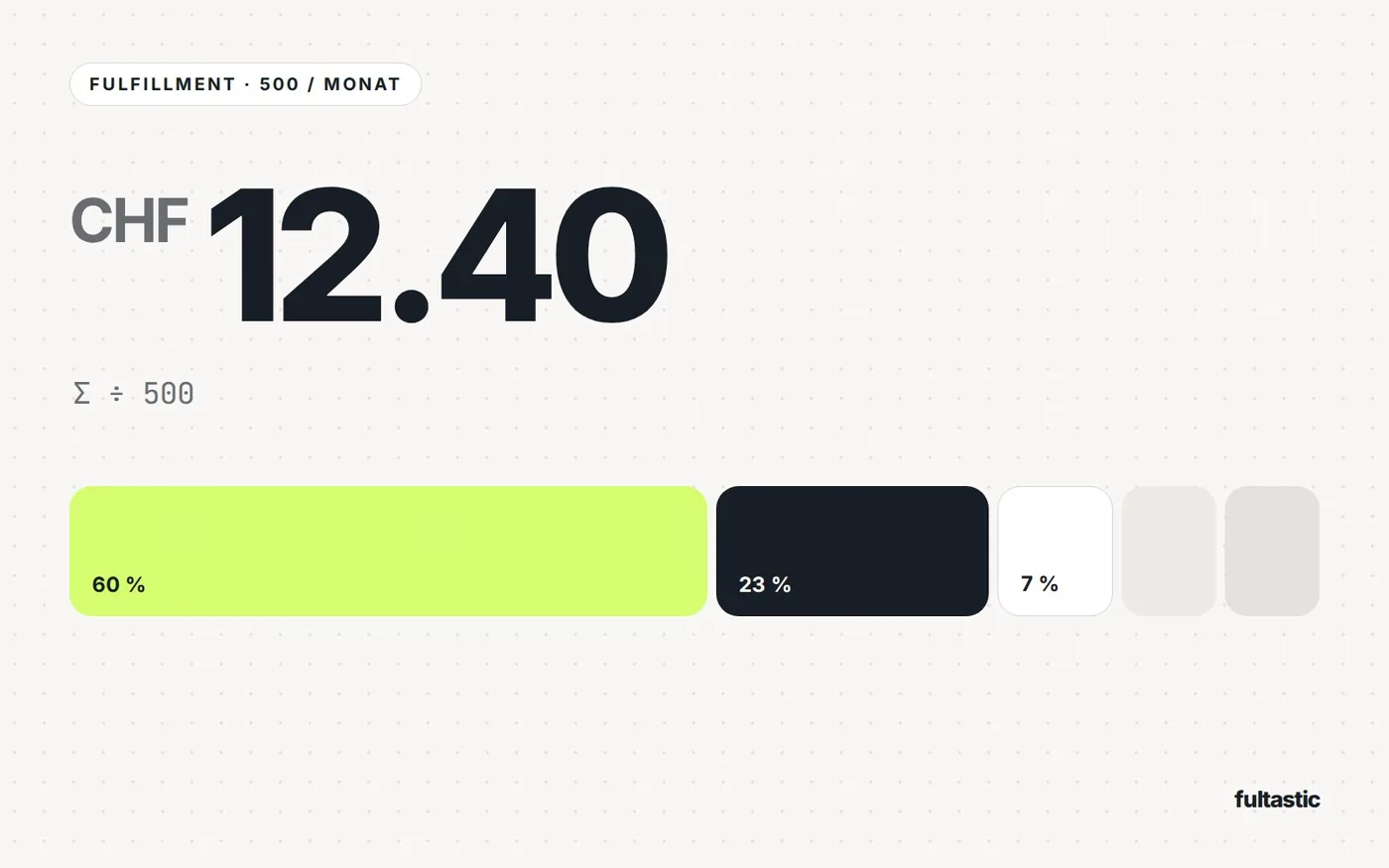
| Per order, all inclusive | 6’200 / 500 | 12.40 |
| of which postage | 7.50 | |
| of which fulfillment excluding postage | 4.90 |
The decisive number is the last row: around five francs per order is what it costs to have someone else store, pick, pack, add inserts, inspect returns and process goods receipt. Everything else is postage – and you pay that either way, usually more if you run your own warehouse.
What happens at 200 and at 2’000 shipments?
Fulfillment scales – but not linearly. The variable costs per order fall as volume grows, because better postage tiers kick in; storage costs rise, because more stock is on the shelves. Here is how the example changes:
| 200 shipments | 500 shipments | 2’000 shipments | |
|---|---|---|---|
| Fulfillment per order (excluding postage) | 4.20 | 4.20 | 4.20 |
| Postage per order | 8.20 | 7.50 | 6.80 |
| Storage + goods receipt per month | 225 | 350 | 950 |
| Total per month | 2’705 | 6’200 | 22’950 |
| Per order, all inclusive | 13.53 | 12.40 | 11.48 |
That is why we work with clients from 200 shipments per month and location upwards: below that, the fixed costs per order are so high that it doesn’t add up for either side. Above it, every additional order gets cheaper.
Comparison: your own warehouse
An honest comparison takes into account not just rent and wages, but also what tends to get forgotten in your own warehouse: postage at standard rates, software, materials, mis-shipments – and the founder’s time, spent taping up parcels instead of selling.
| 500 shipments per month | Own warehouse (CHF) | Fulfillment (CHF) |
|---|---|---|
| Warehouse space, 80 m² at 18 / m² | 1’440 | 300 |
| Staff, 50 % position incl. employer contributions | 3’000 | included in pick & pack: 1’450 |
| Packaging material | 400 | 400 |
| Postage (standard rate 9.50 vs. framework contract 7.50) | 4’750 | 3’750 |
| Shipping software, label printer, scales | 100 | 0 |
| Inserts, returns, goods receipt | 200 | 300 |
| Total per month | 9’890 | 6’200 |
| Per order | 19.78 | 12.40 |
Of course, you can turn the numbers around: if you already have the space and pack everything yourself, you count zero staff costs. That still leaves around 6’700 francs for rent, materials and more expensive postage – and 500 orders at four minutes each are 33 hours a month that don’t go into growth. At the latest with the first seasonal peak or the first bout of illness, you see what your own warehouse really costs: it doesn’t scale.
Hidden costs you need to ask about
Quotes from different providers differ by a few centimes on pick & pack – and by hundreds of francs per month on the following points:
- Monthly base fee or minimum spend. Some providers charge a fixed account fee or a minimum, even in slow months.
- Peak surcharges. Mark-ups in November and December – exactly when you ship the most.
- Long-term storage. Surcharges for goods that sit for longer than six or twelve months.
- Postage surcharges. Fuel surcharge, bulky goods, Saturday delivery, undeliverable shipments – ask what is included in the postage.
- Packaging material at list price. A box at 2.50 instead of 0.80 adds up to 850 francs on 500 shipments.
- Returns refurbishment. “Return 3.00” sounds good until the refurbishment per item is charged separately.
- Integration costs. A connection that is developed “individually” costs money and time. Standard connectors for Shopify, WooCommerce, Shopware or Billbee should be included.
- Notice periods and stock removal fees. What does it cost to leave again? A fair provider will give you the number without hesitation.
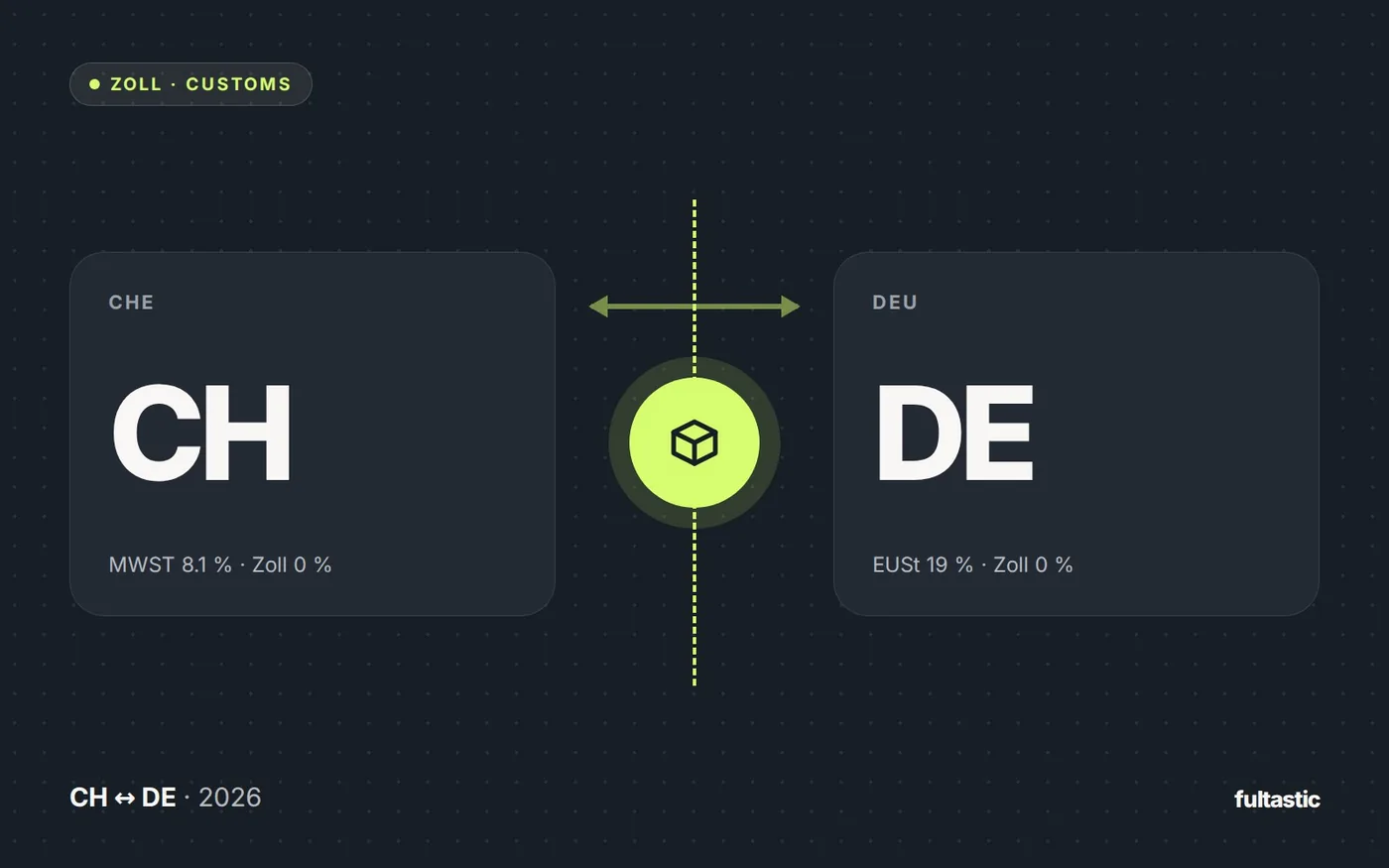
- Customs clearance. If you ship to Switzerland or into the EU, you should know whether the customs declaration is charged per parcel or per pallet – the difference is tenfold. More on this in our customs guide Switzerland ↔ Germany.
How to read a fulfillment quote
Never compare individual prices – always compare the total for your specific profile. For that, you need five numbers from your shop: shipments per month, line items per order, average parcel weight, return rate and storage space required. Send these numbers to every provider and ask for:
- the cost per order, all inclusive except postage,
- the postage rate for your typical parcel including all surcharges,
- the monthly fixed costs (storage, base fees, software),
- the one-off costs (onboarding, integration, initial stock placement),
- the contract terms: duration, notice period, minimum volume, peak surcharges.
Then you calculate: (cost per order + postage) × shipments + fixed costs. That one number is comparable. Everything else is marketing.
When fulfillment pays off – and when it doesn’t
It pays off as soon as you regularly ship a few hundred orders per month, your team needs time for growth, you serve several channels or countries, you have seasonal peaks or you want to enter a second market – for instance from Germany into Switzerland or vice versa, where a warehouse in the destination country saves you customs clearance on every parcel.
It doesn’t pay off (yet) if you are below 100 shipments per month and have the space and time anyway, if your products need a lot of explaining and you want to check every parcel personally, or if your range consists of a few very large or very fragile items for which standard processes don’t fit.
In between, the numbers decide. And we are happy to run them with your real figures: the price calculator shows you in two minutes what your fulfillment would cost with us – from our own warehouses in Switzerland and Germany, with postage through our framework contracts, with no hidden line items.
Frequently asked questions
What does fulfillment cost per order?
For a typical B2C shop with small parcels, the cost excluding postage is around 4 to 6 francs per order in Switzerland and 3.50 to 5 euros in Germany. Including postage, it is roughly 11 to 14 francs or 8 to 10 euros respectively. The exact figure depends on line items per order, parcel weight and volume.
Why don’t providers list prices on their websites?
Because the price depends on your profile – and because a calculation based on a single price would be misleading. A serious quote is based on your numbers. Our price calculator gives you exactly that, without a sales call.
Is postage through a fulfillment provider really cheaper?
Usually, yes: providers pool the volume of many shops and pass on framework contracts with Swiss Post, DHL or other carriers. Depending on volume and parcel profile, savings of up to 30 % compared with standard rates are possible. Get the postage rate for your typical parcel in writing.
Is there a minimum volume?
With most providers, yes – often between 100 and 500 shipments per month. With us, it is 200 shipments per month and location – below that, the partnership doesn’t add up for either side.
Which in-house warehouse costs disappear when I outsource?
Rent, warehouse equipment, shipping software, label printers, packaging material at small-quantity prices, postage at standard rates and, above all, staff time – including holiday cover, sick leave and seasonal peaks.
As of: October 2026. All amounts are indicative figures for guidance only and not a price commitment.