
Switzerland is an attractive market for German online retailers: high purchasing power, German-speaking, close by. For tax purposes, however, it is a foreign country – with its own VAT, its own tax administration and its own rules on when you have to register. This guide explains when a German company becomes liable for Swiss VAT, what fiscal representation is, how the declaration of subordination (Unterstellungserklärung Ausland) works and how to set the whole thing up so that your Swiss customers shop with you as if you were a Swiss store.
Swiss VAT in three minutes
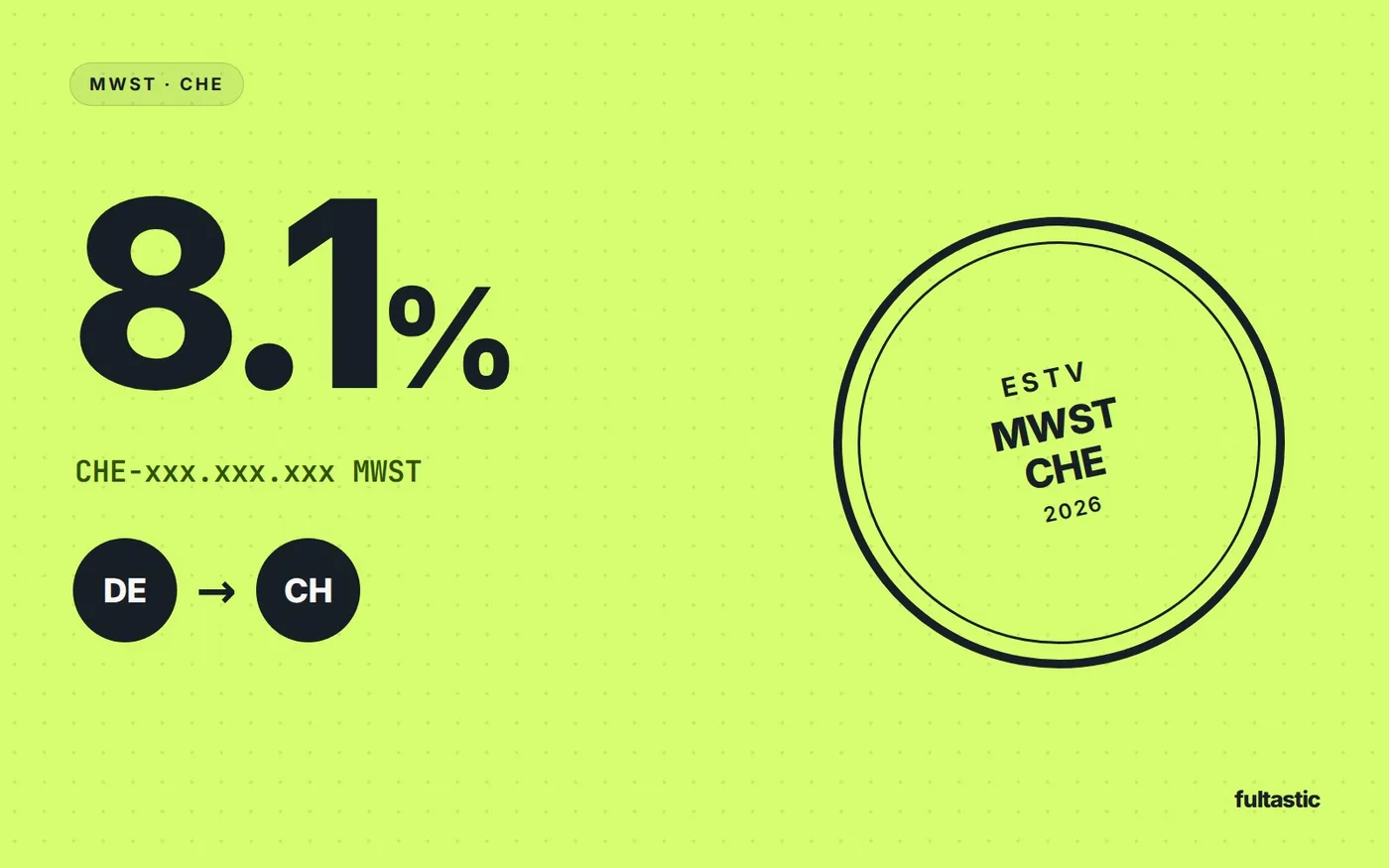
Switzerland has its own VAT system that has nothing to do with the EU system. The authority in charge is the Swiss Federal Tax Administration (FTA) in Bern. The key figures since 1 January 2024:
| Rate | Applies to |
|---|---|
| 8.1 % standard rate | Most goods: clothing, cosmetics, electronics, household goods, sports equipment, toys |
| 2.6 % reduced rate | Food and non-alcoholic beverages, books, newspapers, medicines |
| 3.8 % special rate | Accommodation – not relevant for online retailers |
There are three terms you should keep apart: import VAT is levied by customs when goods enter Switzerland – it corresponds to VAT on the value of the goods including shipping. Domestic VAT is what you owe on sales within Switzerland once you are liable for VAT. And input tax is what you are allowed to claim back: a company registered in Switzerland deducts the import VAT it has paid from the domestic VAT it owes. For a company that is not registered, on the other hand, import VAT is a genuine cost – or the customer pays it at the front door.
Important on the German side: from a German perspective, your delivery to Switzerland is a tax-exempt export supply. You do not charge German VAT – but you do need proof of export for that (export declaration or shipping document with customs endorsement).
Three routes into Switzerland – and what they mean for tax
| 1. Shipping from Germany, customer clears customs (DAP) | 2. Shipping from Germany, you clear customs (DDP) | 3. Warehouse in Switzerland | |
|---|---|---|---|
| Who pays the import VAT? | Your customer, plus the parcel carrier's customs clearance fee | You – recoverable as input tax | You – on the pallet delivery, recoverable as input tax |
| Swiss VAT registration | Only from CHF 100’000 in revenue from low-value consignments | Yes, with declaration of subordination | Yes (from CHF 100’000 in worldwide revenue) |
| Fiscal representative | Only once registered | Yes | Yes |
| Price in your shop | Without Swiss VAT – customer pays it on delivery | Including 8.1 % VAT | Including 8.1 % VAT |
| Customer experience | Additional charges, 5–10 days | No additional charges, 3–6 days | Like a Swiss shop, 1 day |
| Returns | Across the border | Across the border | Within Switzerland |
Route 1 is the default for every shop that “also ships to Switzerland” – and the reason many of them hardly sell anything there. Routes 2 and 3 require Swiss VAT registration – and that is exactly what puts many people off. Wrongly so, as the next sections show.
When you become liable for VAT in Switzerland
The Swiss VAT Act has three typical triggers for foreign companies:
1. Supplies within Switzerland and CHF 100’000 in worldwide revenue
Anyone who makes taxable supplies in Switzerland and generates more than CHF 100’000 in annual revenue worldwide is liable for VAT. The crucial point: what counts is worldwide revenue, not just Swiss revenue. A German shop with 2 million euros in annual revenue that imports under the declaration of subordination or ships from a Swiss warehouse is liable for VAT from the very first franc.
2. The mail-order rule
Low-value consignments – parcels on which the import VAT would be less than CHF 5, i.e. up to roughly CHF 62 in goods value – are not taxed at the border. Anyone who generates more than CHF 100’000 in annual revenue in Switzerland with such consignments becomes liable for VAT from the following month – and from then on has to account for Swiss VAT on all deliveries to Switzerland, including the large parcels. Typical for cosmetics, supplements, accessories and anything with a small basket size.
3. Platforms
Since 1 January 2025, online platforms that facilitate sales have themselves been deemed the supplier in Switzerland. If you sell to Switzerland via a marketplace, the marketplace may take over the VAT accounting – which does not automatically cancel your own obligations. If you combine a marketplace with your own shop, you should keep the two cleanly separated.
What fiscal representation is – and what it is not
A foreign company without a registered office in Switzerland must appoint a representative domiciled or established in Switzerland for VAT purposes: the fiscal representative. The representative is the address for service for the FTA, files the VAT returns, answers queries and keeps deadlines. In other words, your administrative arm in Switzerland.
What the representative is not: the person liable for the tax. You still owe the tax. Unlike in some EU countries, the Swiss fiscal representative is not liable for your tax debts. That is why the FTA additionally requires a security deposit from you: usually a bank guarantee or a cash deposit based on your expected revenue.
In principle, any company based in Switzerland can act as fiscal representative – a fiduciary firm, a law firm or a logistics partner. The advantage of a logistics partner: it already has the import data, the stock movements and the sales figures in its system and can handle customs clearance, import VAT and VAT returns from a single source. That is exactly what we offer with our fiscal representation in Switzerland.
Registration step by step
- Check your VAT liability. Worldwide revenue, revenue from low-value consignments, planned sales channel (DDP or warehouse). This determines whether and from when you have to – or should – register.
- Appoint a fiscal representative. Contract with the representative and written power of attorney.
- Arrange the security deposit. Bank guarantee from a Swiss bank or cash deposit with the FTA. The FTA sets the amount based on your expected Swiss revenue; for a medium volume, expect a low five-figure amount in francs.
- Register with the FTA. Online form with commercial register extract, details of your business activity and revenue, power of attorney for the representative and proof of the security deposit. You will then receive your Swiss VAT number in the format CHE-123.456.789 MWST.
- Submit the declaration of subordination if you want to import individual shipments DDP (see next section).
- Adapt your shop. Swiss prices including 8.1 % VAT, invoices with your Swiss VAT number, accounting with CHF accounts.
Realistically, the path from decision to active VAT number takes several weeks – the bank guarantee is usually the slowest step. So plan your registration before your market launch, not after.
The declaration of subordination (Unterstellungserklärung Ausland)
Normally, the recipient of an import is the importer – and owes the import VAT. With the declaration of subordination, you declare to the FTA that you yourself act as the importer. The consequences:
- You owe the import VAT on every shipment and deduct it as input tax – the net cost to you is zero.
- Your delivery counts as a domestic supply: you charge the customer 8.1 % Swiss VAT and remit it quarterly.
- Your customer receives the parcel without any additional charges and without a customs clearance fee.
The declaration of subordination applies to all imports, not just individual ones. It requires VAT registration and a parcel carrier that clears customs on your behalf. It is the key to Route 2 – and you do not need it for Route 3, because there you import in consolidated pallet shipments and in your own name anyway.
Day-to-day operations: VAT returns, invoices, prices
VAT returns
Registered companies generally file quarterly returns: domestic revenue, VAT owed, deductible input tax (above all the import VAT from the customs assessment decisions) – and pay or reclaim the difference. Your fiscal representative files the return online; you provide the sales figures and import documents.
Invoices
Invoices to Swiss customers must show your Swiss VAT number, the VAT rate and the VAT amount in francs. For your business customers this is mandatory so they can deduct input tax; for private customers it is a matter of trust.
Prices
The Swiss Price Disclosure Ordinance requires that consumers are shown final prices including all taxes and fees. A shop that displays net prices and adds VAT at checkout is in breach of it. So calculate your prices in francs including 8.1 % – and make a conscious decision whether to convert your German price list one to one or to price specifically for Switzerland.
Accounting
Keep your Swiss sales separate and in francs. Your German advance VAT return shows the deliveries as tax-exempt exports; the Swiss VAT return shows them as taxable domestic sales. The two have to match – something tax auditors on both sides like to look at.
The practical solution: a warehouse in Switzerland
Most of the German brands we work with choose Route 3 – not because of the tax, but because of the logistics: once a month, a pallet travels from Germany to Bettwiesen, is cleared through customs once, and the import VAT ends up as input tax in the VAT return. From then on, every shipment is a domestic shipment: Swiss Post, next-day delivery, Swiss returns address, Swiss VAT on the invoice. To your customer, your shop is a Swiss shop.
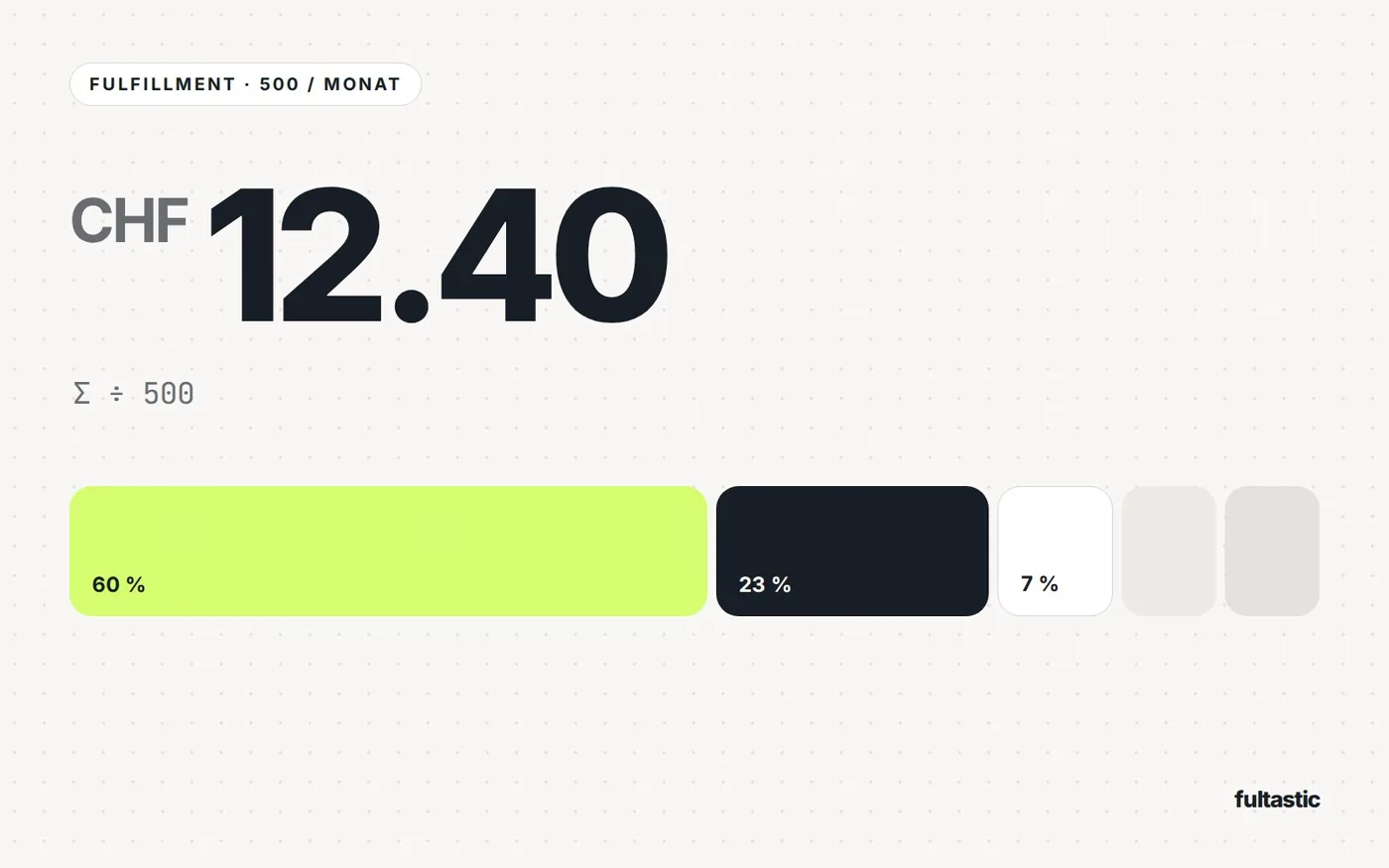
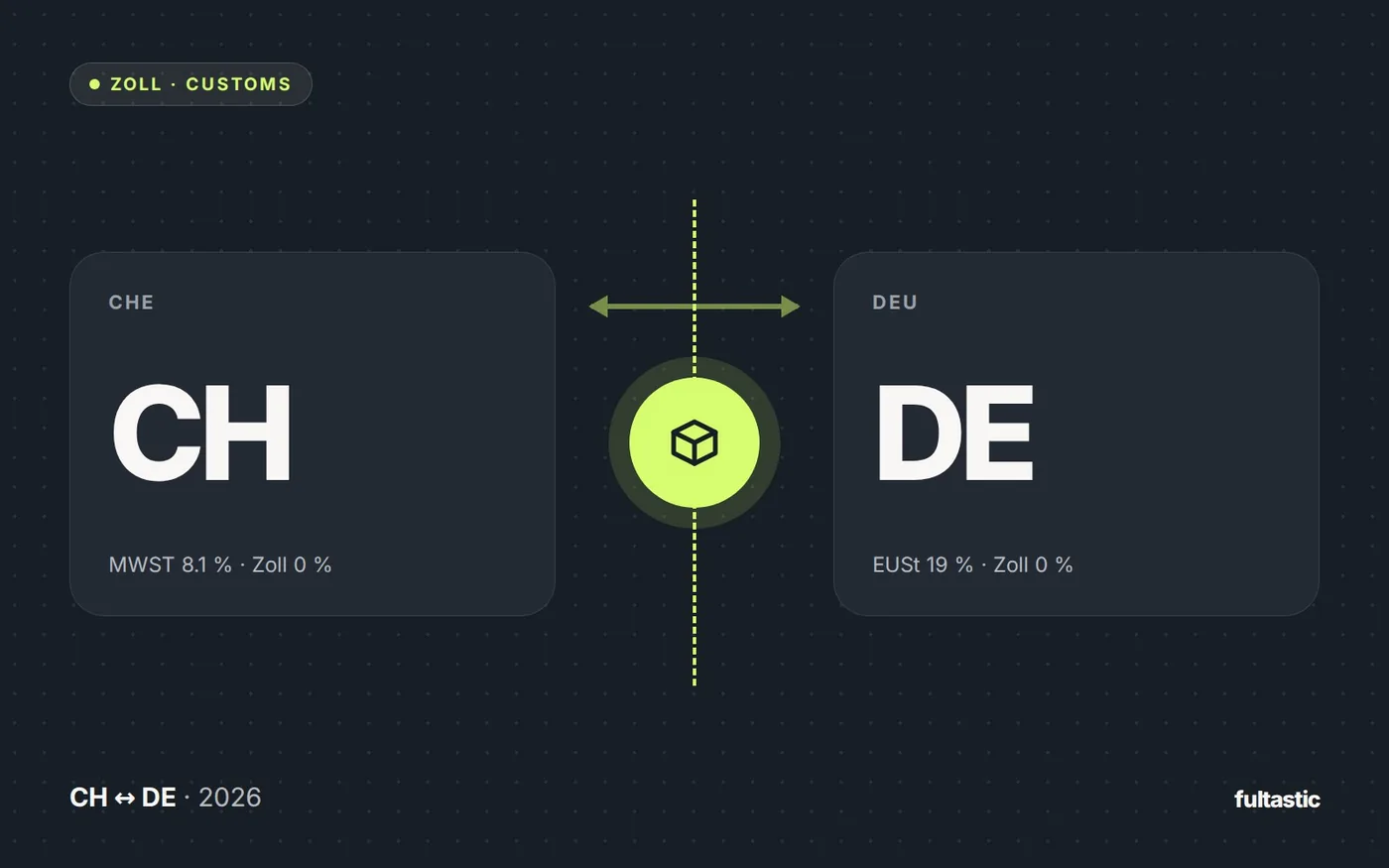
In tax terms, little changes compared with Route 2 – you need registration, a fiscal representative, a security deposit and VAT returns either way. In logistics terms, everything changes: customs clearance is per pallet instead of per parcel, postage is at domestic rates, returns stay in the country. The sample calculation in the article What does fulfillment really cost? shows what that means in francs, and the customs guide Switzerland ↔ Germany explains the customs side.
What it costs – and what you get for it
Registration costs you three things: a one-off flat fee for setup, a fixed annual fee for fiscal representation and VAT returns, and the capital tied up in the security deposit. The VAT itself is a pass-through item: you collect it from the customer and remit it; the import VAT you claim back.
Set against that is what Route 1 costs without ever showing up on an invoice: customers who abandon the checkout because it says “customs charges may apply”; parcels that are refused at the front door and come back at your expense; reviews that talk about additional charges. Anyone shipping more than a few hundred parcels a year to Switzerland usually loses more margin with Route 1 than the registration costs.
Common mistakes
- Applying the CHF 100’000 threshold to Swiss revenue. What counts is worldwide revenue – and for the mail-order rule, revenue from low-value consignments to Switzerland.
- Showing net prices and adding VAT at checkout. Not permitted in Switzerland – and a conversion killer.
- Not claiming import VAT as input tax. Without the customs assessment decision as evidence, you give away 8.1 % on every pallet.
- Forgetting proof of export in Germany. Without documentation, a tax-exempt export becomes a taxable supply – 19 % out of your margin.
- Returns without proof of returned goods. Then you pay import VAT again when the goods come back to Germany.
- Starting too late. The bank guarantee and registration take weeks. If you want to register in October for the Christmas season, you are cutting it fine.
Checklist
- Determine your worldwide revenue and Swiss revenue from low-value consignments over the last 12 months.
- Decide on your sales channel: DDP from Germany or a warehouse in Switzerland.
- Appoint a fiscal representative and sign the power of attorney.
- Arrange the security deposit with your bank.
- Submit your registration to the FTA and wait for your VAT number.
- For DDP: submit the declaration of subordination (Unterstellungserklärung Ausland) and set up a parcel carrier with DDP service.
- Shop: prices in francs including 8.1 %, invoice layout, Swiss returns address.
- Accounting: CHF accounts, proof of export, import documents.
- Go through the first quarterly VAT return with your fiscal representative.
Frequently asked questions
As a German online shop, do I absolutely need a fiscal representative in Switzerland?
As soon as you are liable for VAT in Switzerland, yes: companies without a registered office in Switzerland must appoint a representative based in Switzerland. As long as you are not liable for VAT – for example, below CHF 100’000 in revenue from low-value consignments and without a warehouse in Switzerland – you do not need one.
Is the fiscal representative liable for my taxes?
In Switzerland, no. The fiscal representative is the address for service and your administrative representative. You are liable for the tax; that is why the FTA requires a security deposit.
How much is the security deposit?
It depends on your expected taxable revenue in Switzerland and is set by the FTA. For medium volumes, a low five-figure amount in francs is typical, as a bank guarantee or cash deposit. We will tell you what to expect before you register.
Can I register voluntarily?
Yes. It is often worthwhile even before you reach the threshold, because you can then ship DDP, claim back import VAT as input tax and offer your customers a clean shopping experience.
What about Austria and other EU countries?
Within the EU, the One-Stop-Shop (OSS) procedure applies – this has nothing to do with Switzerland. Switzerland is a third country; registration there comes on top of your EU obligations.
Does fultastic provide tax advice?
We handle fiscal representation, VAT returns and customs clearance – and work closely with your tax advisor in the process. Questions about your overall tax planning are for your tax advisor; the Swiss side of the process is ours.
Last updated: October 2026. This guide is no substitute for tax advice; rates, thresholds and procedures are subject to change.